Risk Measurement & Prioritization Models
Security teams often generate large volumes of findings without a defensible prioritization framework
We advise on the development of:
- Risk scoring methodologies aligned to business impact
- Exposure classification models tied to operational criticality
- Remediation prioritization frameworks balancing risk and feasibility
- Structured vulnerability governance dashboards for leadership review
Oversight Structures & Accountability
Security posture cannot rely on informal coordination. Effective governance requires clear ownership and defined oversight structures.
We support the establishment of:
- Defined remediation ownership models across business units
- Escalation pathways for unresolved high-risk findings
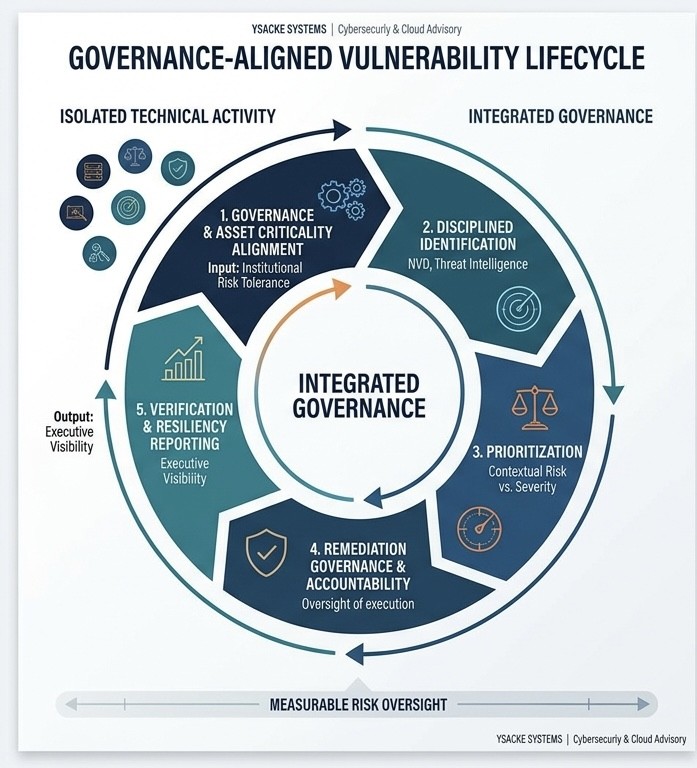
- Governance review cadence for vulnerability posture and risk exposure
- Executive reporting structures that translate technical risk into operational impact
- Our advisory ensures that security oversight becomes part of operational governance — not an isolated technical function.
Regulatory & Federal Alignment in Practice
Regulated and federal-aligned environments require defensible oversight models.
We align governance structures to:
- Remediation ownership models across business units
- Escalation pathways for unresolved high‑risk findings
- Governance review cadences for vulnerability posture and risk exposure
- Executive reporting structures translating technical risk into operational impact
Governance is not documentation.
It is measurable control over risk exposure, remediation execution, and institutional accountability.
YSACKE structures that control.
Federal Alignment Layer
For regulated and federal-aligned environments, we structure cloud advisory in alignment with:
- NIST SP 800-53 control families
- NIST Risk Management Framework (RMF)
- Federal Zero Trust Architecture principles
- CISA guidance for cloud security posture
- FISMA-aligned documentation expectations.
Cloud architecture must be defensible under audit — not simply functional
Enterprise Security Integration
Cloud architecture does not operate in isolation. It must integrate with vulnerability governance, risk oversight, identity management, and executive reporting structures.
YSACKE ensures cloud security architecture is embedded within enterprise-wide governance frameworks — not treated as a parallel initiative.
This prevents fragmentation and preserves institutional accountability.
Secure infrastructure is not defined by provider selection — but by disciplined architectural governance.
YSACKE ensures cloud execution remains aligned with institutional governance, measurable risk tolerance, and defensible security posture.